

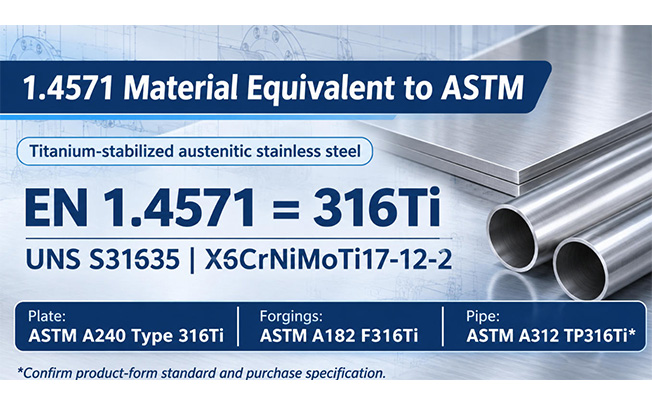
If you are sourcing EN 1.4571 stainless steel for chemical processing equipment, industrial pipelines, heat exchangers, or welded pressure components, the most commonly recognized ASTM/AISI equivalent is 316Ti stainless steel (UNS S31635). It is a titanium-stabilized austenitic stainless steel containing approximately 17% chromium, 12% nickel, and 2% molybdenum.
1. What Is the ASTM Equivalent of 1.4571 Stainless Steel?
EN 1.4571 is generally equivalent to AISI 316Ti and UNS S31635. Its European designation is X6CrNiMoTi17-12-2. It belongs to the austenitic chromium-nickel-molybdenum stainless steel family and is stabilized with titanium to reduce the risk of sensitization during welding and exposure to elevated temperatures.
1.4571 Equivalent Material Designations
| Standard System | Material Designation | Description |
|---|---|---|
| EN Material Number | 1.4571 | European material number |
| EN Grade | X6CrNiMoTi17-12-2 | European chemical designation |
| DIN | X6CrNiMoTi17-12-2 | German designation |
| AISI | 316Ti | Titanium-stabilized stainless steel |
| UNS | S31635 | Unified Numbering System |
| ASTM Pipe Grade | TP316Ti | Austenitic stainless steel pipe |
| JIS | SUS316Ti | Japanese designation |
| Common Trade Name | 316Ti | Titanium-stabilized 316-type steel |
Which ASTM Standard Is Used for 1.4571?
| Product Form | Common ASTM Specification | Material Designation |
|---|---|---|
| Stainless steel plate and sheet | ASTM A240 / ASME SA240 | Type 316Ti, where included in the applicable specification |
| Seamless and welded pipe | ASTM A312 / ASME SA312 | TP316Ti |
| Seamless and welded tubing | ASTM A213 / ASTM A269 | TP316Ti, where applicable |
| Forged components | ASTM A182 / ASME SA182 | F316Ti, subject to grade and specification verification |
| Bars and billets | Product-form-specific ASTM standards | Confirm the applicable grade and delivery condition |
For example, if you are purchasing 1.4571 seamless stainless steel pipes, the purchase description should identify ASTM A312 TP316Ti, the required dimensions, manufacturing process, heat treatment, and testing requirements.ASTM A312 covers seamless, straight-seam welded, and heavily cold-worked austenitic stainless steel pipes for high-temperature and general corrosive service.
Typical EN 1.4571 Chemical Composition (%)
| Element | Symbol | EN 1.4571 Typical Specification (%) | Main Function |
|---|---|---|---|
| Carbon | C | ≤ 0.08 | Strength and carbide formation |
| Chromium | Cr | 16.5–18.5 | Corrosion and oxidation resistance |
| Nickel | Ni | 10.5–13.5 | Austenitic structure |
| Molybdenum | Mo | 2.0–2.5 | Resistance to pitting and crevice corrosion |
| Titanium | Ti | ≥ 5 × C, subject to standard limits | Stabilization against chromium carbide formation |
| Manganese | Mn | ≤ 2.0 | Deoxidation and strengthening |
| Silicon | Si | ≤ 1.0 | Deoxidation |
| Phosphorus | P | ≤ 0.045 | Controlled impurity |
| Sulfur | S | ≤ 0.030 | Controlled impurity |
| Iron | Fe | Balance | Base metal |
Mechanical Properties of EN 1.4571 / 316Ti
| Property | EN 1.4571 Typical Minimum / Maximum Requirement |
|---|---|
| Tensile Strength (Rm) | 500–700 MPa |
| 0.2% Proof Strength (Rp0.2) | ≥ 200 MPa |
| Elongation (A5) | Typically ≥ 40% for relevant product conditions |
| Hardness | Typically ≤ 215 HB |
| Density | Approximately 8.0 g/cm³ |
| Elastic Modulus | Approximately 200 GPa |
Note: These are representative EN product-form values, not universal ASTM acceptance limits. Actual mechanical requirements vary with product form, thickness, manufacturing route, and applicable standard.
316 vs. 316L vs. 321 Chemical Composition Comparison (%)
| Element | 1.4571 / 316Ti | 316L | 316 | 321 |
|---|---|---|---|---|
| UNS | S31635 | S31603 | S31600 | S32100 |
| Chromium | 16.5–18.5 | 16–18 | 16–18 | 17–19 |
| Nickel | 10.5–13.5 | 10–14 | 10–14 | 9–12 |
| Molybdenum | 2.0–2.5 | 2–3 | 2–3 | — |
| Carbon | ≤ 0.08 | ≤ 0.030 | ≤ 0.08 | ≤ 0.08 |
| Titanium | Stabilized | — | — | Stabilized |
| Main Feature | Ti stabilization and Mo alloying | Low carbon | Mo alloying | Ti stabilization |
GNEE 1.4571 / 316Ti Stainless Steel Supply
GNEE supplies stainless steel materials for industrial buyers, distributors, engineering contractors, and project procurement teams. For 1.4571 / 316Ti inquiries, buyers can specify the required ASTM or EN standard, product dimensions, manufacturing process, and inspection requirements.
Available product forms and supply arrangements can be confirmed according to the project specification, including:
- 316Ti stainless steel pipes and tubes.
- 316Ti stainless steel plates and sheets.
- Stainless steel bars and other product forms subject to production availability.
- EN 10204 3.1 material test certificates and heat-number traceability.
- Chemical composition and mechanical property verification.
- PMI, dimensional inspection, and agreed additional testing.
- Export packaging and shipment documentation.
FAQ
Q1: What is the ASTM equivalent of EN 1.4571?
The commonly recognized ASTM/AISI equivalent is 316Ti stainless steel, UNS S31635. For pipes, the corresponding designation is commonly ASTM A312 TP316Ti. The exact ASTM specification depends on product form.
Q2: Is 1.4571 the same as 316Ti?
Yes, EN 1.4571 is commonly cross-referenced to AISI 316Ti and UNS S31635. Both refer to titanium-stabilized austenitic chromium-nickel-molybdenum stainless steel. However, product standards and acceptance requirements must be checked separately.
Q3: What is the UNS number of 1.4571?
The commonly used UNS number is S31635, which identifies 316Ti stainless steel.
Q4: Is ASTM A312 TP316Ti equivalent to 1.4571?
ASTM A312 TP316Ti is the commonly used pipe-grade designation corresponding to EN 1.4571. Buyers should verify chemical composition, mechanical properties, manufacturing requirements, and testing against the applicable editions of both specifications.
Q5: What is the difference between 1.4571 and 1.4404?
1.4571 corresponds to 316Ti, which is titanium-stabilized. 1.4404 corresponds to 316L, which has a lower maximum carbon content. Both contain molybdenum and offer good corrosion resistance, but they use different approaches to controlling sensitization.
Q6: Is 1.4571 better than 316L?
Neither grade is universally better. 316L is often preferred when low-carbon welding requirements are specified. 1.4571 is useful when a titanium-stabilized grade is required, particularly for certain welded or elevated-temperature applications.
Q7: Can 1.4571 stainless steel be welded?
Yes. 1.4571 is weldable using suitable procedures and filler materials. Welding procedures should be selected according to material thickness, joint design, service environment, and applicable construction codes.
Q8: Is 1.4571 suitable for seawater applications?
Not generally for severe continuous seawater exposure. Although it contains molybdenum, its pitting and crevice corrosion resistance is limited compared with duplex 2205 and super duplex 2507. The actual seawater temperature, flow, chloride concentration, and crevice conditions must be evaluated.
Q9: What is the maximum temperature for 316Ti?
There is no single universal maximum temperature applicable to every 316Ti product and application. The allowable operating temperature depends on mechanical loading, oxidation, creep, service duration, and the relevant design code.